The state of AI disclosure in Europe, August 2026
We scanned 494 ordinary business websites in 17 EU countries, 26 days after Article 50 took effect. Under 1% label their AI content. The numbers, by country and sector, with the method.
Part of our guide to the EU AI disclosure rules.
This report is not legal advice. It is a count. On 28 August 2026, 26 days after the EU AI Act's disclosure duty took effect, we pointed our scanner at 494 ordinary business websites across 17 EU countries and asked two questions: does any of this look AI-assisted, and if so, does the page say so? The answers are below, with the method, so anyone can argue with them.
The thirty-second version
Almost nobody has started. Of 494 business websites, 5 carry any kind of notice about AI anywhere on the site, and 3 put a label on the actual content: one article marked as AI-generated, one set of product images, one photo caption. That is under 1%. Meanwhile the scanner read 69 sites (14%) as publishing at least one page of AI-assisted text, and not one of those pages disclosed it. Add the weaker image signal and 210 sites (43%) have at least one page our scanner would flag: content that looks AI-assisted, no disclosure alongside it.
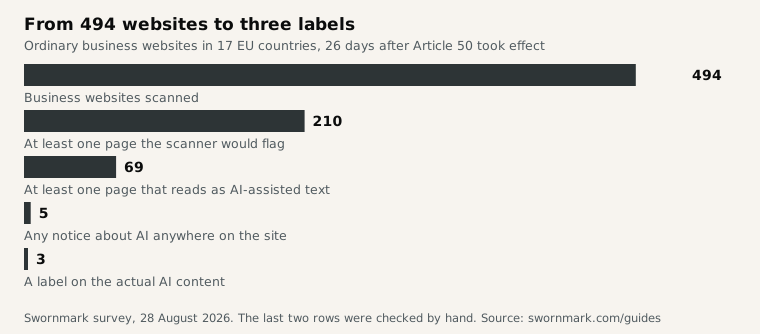
Whichever way you cut the AI signal, the disclosure side of the ledger is nearly empty. That is the finding. The rest of this page is the detail.
Who we looked at
We wanted the people the rules actually reach, which is not the top 500 sites in Europe. Those are platforms, media, government and telcos, and they have lawyers. We wanted the hotel, the software company, the online shop, the insurance broker: businesses whose websites quietly filled up with AI-assisted copy and imagery since 2023, mostly without anyone deciding that they should.
So we took the Tranco list, a research ranking of the world's most visited domains, and drew at random from country domains ranked between 10,000 and 300,000 globally. Big enough to be real businesses with real traffic, small enough that nobody has a compliance team. We drew 1,725 candidates weighted towards the larger markets, and had the scanner read each homepage and classify it. Media, platforms, public bodies, universities, charities and personal sites were set aside. Sites that would not let a scanner in were set aside too, and there were a lot of them: 533 of the 1,725 returned an error or a block, which is its own small finding about how much of the European web now sits behind bot protection. What remained were 494 ordinary businesses.
| Country | Sites | Country | Sites |
|---|---|---|---|
| Germany | 83 | Sweden | 19 |
| Italy | 61 | Denmark | 17 |
| France | 56 | Czechia | 16 |
| Netherlands | 53 | Finland | 16 |
| Spain | 48 | Portugal | 14 |
| Poland | 44 | Ireland | 11 |
| Austria | 20 | Greece, Hungary, Romania | 16 |
| Belgium | 20 |
By sector, the sample leans the way the European web leans: 166 retail and e-commerce sites, 152 software and IT businesses, 47 in finance and insurance, 26 in travel and hospitality, 18 marketing and creative agencies, and the rest spread across health, professional services, automotive, manufacturing, construction, food and education. Roughly two thirds sell to consumers, one third to other businesses.
What the scanner did
Each site got the same treatment a free Swornmark scan gives a prospect. The scanner finds up to 8 pages per site, sitemap first, navigation links second, reads the text of each, counts the images, searches the whole page for anything that looks like a disclosure phrase, and then asks a language model three questions about the page: does the body text plausibly include AI-generated or AI-assisted copy, could the page carry AI-generated imagery, and does the page disclose its own use of AI anywhere, footer and author notes included. It is instructed to be cautious, to treat photographs of real premises and products as not AI, and never to flag imagery on missing alt text alone.
That gave us 2,646 distinct pages after removing duplicates and the odd machine endpoint a sitemap throws up. Every page came back with a judgement and a confidence. Most of the text flags were medium confidence, which is honest: telling AI-assisted marketing copy from merely bland marketing copy is a judgement, not a measurement, and we say so to customers too. The disclosure side is far more solid, because a disclosure is a sentence you can point at, and we checked every single one by hand. More on that below.
What we found
The scanner flagged at least one page on 210 of the 494 sites. Flagged means the page had an AI signal, text or image, and no disclosure on it. The share varies by country more than we expected.
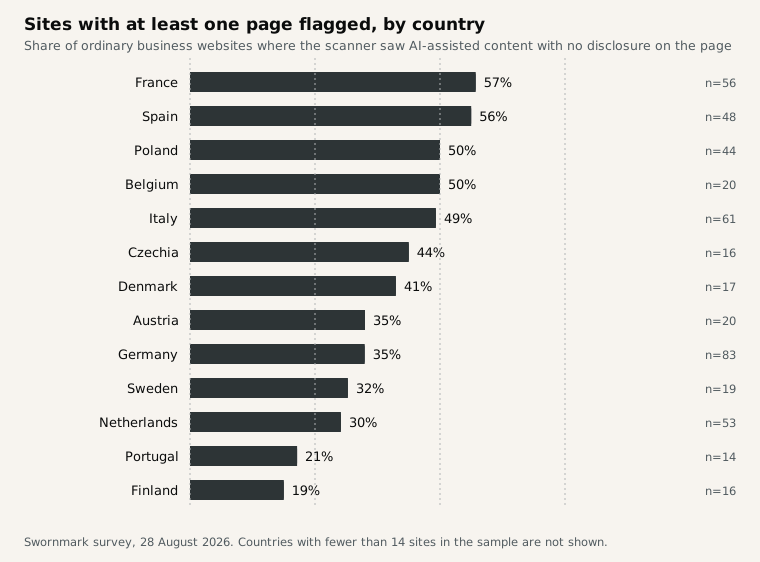
France and Spain sit at the top, with well over half of sites carrying at least one flagged page, and a quarter of sites in each reading as having AI-assisted text somewhere. Germany, the Netherlands and the Nordics sit lower. We would not read too much into the ordering of neighbours a few points apart, but the gap between the top and the bottom of that chart is not noise.
| Country | Sites | Any AI-assisted text | Any flagged page |
|---|---|---|---|
| France | 56 | 23% | 57% |
| Spain | 48 | 25% | 56% |
| Poland | 44 | 7% | 50% |
| Belgium | 20 | 25% | 50% |
| Italy | 61 | 13% | 49% |
| Czechia | 16 | 6% | 44% |
| Denmark | 17 | 0% | 41% |
| Austria | 20 | 10% | 35% |
| Germany | 83 | 11% | 35% |
| Sweden | 19 | 5% | 32% |
| Netherlands | 53 | 15% | 30% |
| Portugal | 14 | 14% | 21% |
| Finland | 16 | 0% | 19% |
By sector the pattern is the one anyone who has worked in marketing would guess.
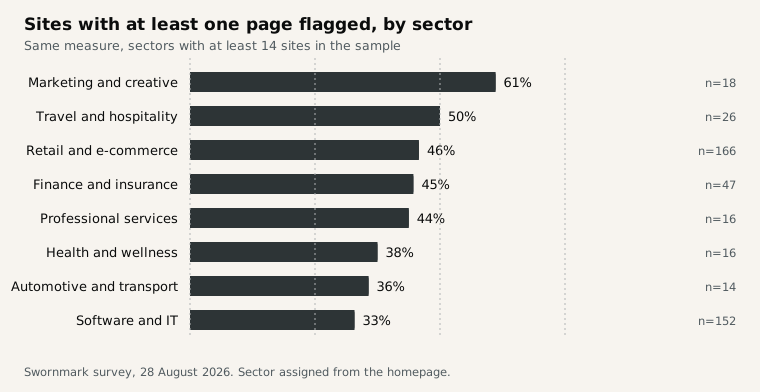
Marketing and creative agencies lead at 61%, and they lead by a wider margin on text specifically: 8 of the 18 agencies in the sample (44%) had at least one page that read as AI-assisted copy. These are the businesses that write other people's websites. Travel and hospitality follow at 50%, then retail at 46%, where the signal is mostly imagery on product and category pages rather than prose. Software and IT businesses, who you might expect to be early adopters of the tools, sit lowest at 33%, though a fifth of them still had at least one page of AI-assisted text.
| Sector | Sites | Any AI-assisted text | Any flagged page |
|---|---|---|---|
| Marketing and creative | 18 | 44% | 61% |
| Travel and hospitality | 26 | 23% | 50% |
| Retail and e-commerce | 166 | 7% | 46% |
| Finance and insurance | 47 | 21% | 45% |
| Professional services | 16 | 19% | 44% |
| Health and wellness | 16 | 6% | 38% |
| Automotive and transport | 14 | 14% | 36% |
| Software and IT | 152 | 14% | 33% |
Whether a business sells to consumers or to other businesses made little difference: 45% of B2C sites and 38% of B2B sites had a flagged page, and the text share was 14% in both. Nor did size, at least within this band: sites ranked 10,000 to 50,000 were flagged at the same rate as sites ranked 150,000 to 300,000.
The disclosure side
This is the number that matters, and the one we are most confident in.
The scanner read 14 sites as carrying a disclosure somewhere. We then read all 14 ourselves, because a first-pass triage is exactly that, and the result is instructive. On 9 of the 14, what the scanner had found was either a company advertising an AI product, an AI website builder, an AI assistant for a construction app, an AI wine sommelier, AI-powered trading tools, or a note that AI is used somewhere in the business, such as in handling support requests or writing software. None of that is a disclosure that the content in front of you was made with AI. We struck those.
That leaves 5 sites out of 494 with a genuine notice of some kind, and they are worth describing because they show what early compliance actually looks like in the wild. A Belgian insurance broker labels an article on its news page "AI Generated". An Italian fashion retailer marks product images on its sale pages "AI generated", each one, which is the closest thing in the sample to the label the Act describes. A Danish telecoms shop captions a router photo "this image was created with AI". A German pump manufacturer notes that its site assistant delivers AI-generated content. And a tax app carries "Made with love and AI" in its footer, which is charming and probably not what Article 50 has in mind.
Three of the five are labels on specific content. The other two are general notices. And of the 69 sites the scanner read as publishing AI-assisted text, none had a disclosure on the page in question. The scanner thought two did; on both, the only mention of AI turned out to be a product pitch.
Put the two halves together and the picture is this: a meaningful share of ordinary European business websites are publishing content that looks AI-assisted, and close to none of them are saying so. Not because they have decided not to. In most cases, we would guess, because nobody has told them the question exists.
What it does not say
A few things this survey cannot tell you, stated plainly so nobody has to discover them later.
It cannot tell you that 43% of business websites are breaking the law. The Act's text duty applies to AI-generated text published to inform the public on matters of public interest, with an exemption where a person has reviewed it and holds editorial responsibility, and the image duty applies to deep fakes and to AI images in the sense the Act defines. A product description, a hotel room blurb, a category page: some of that content is inside the duty and some is not, and the answer depends on facts a scanner cannot see, like whether anyone reviewed it. What the survey measures is exposure: content that looks AI-assisted, with nothing on the page that would count as a disclosure if it turned out to be. That is the question a regulator or a complainant would start with too.
It cannot tell you the exact share of AI-assisted content. The text judgement is a model's read of prose, most of it at medium confidence, and a spot check of flagged pages found generic marketing and category copy that could as easily be human-written as not. It is a read, not a detection, and it probably over-counts. Treat the 14% as a ceiling and an order of magnitude, not a decimal. It is also exactly the read a customer's free scan gets, which is why we report it rather than tune it after the fact.
It cannot tell you about the sites that blocked us. A third of the candidates would not let a well-behaved scanner in. If bot-blocking correlates with anything relevant, and it plausibly correlates with having a more professional web operation, the sites we could not see may differ from the ones we could.
It says nothing about any individual site. We publish aggregates only. The scanner's per-site results are research data and will stay that way.
Method, in full
Sample frame: the Tranco top one million list, downloaded 28 August 2026. Candidate domains were those with an EU member state country code, a global rank between 10,000 and 300,000, and no subdomain. From those we drew at random, with larger draws for larger markets, 1,725 candidates in two rounds. Each candidate's homepage was fetched and classified by the scanner's language model into a site type and a sector; only sites classified as businesses proceeded. 533 candidates were unreachable (an error, a block, or a timeout), 696 were classified as something other than an ordinary business, and 2 failed at scan time. 494 were scanned in full.
Scan: for each site, up to 8 pages discovered from the sitemap or, failing that, from the homepage's links, fetched with a plain user agent identifying itself as the Swornmark scanner. Each page's text was extracted, sampled from the start and the end for long pages, searched in full for common disclosure phrases, and assessed by the scanner's language model against three yes-or-no questions with a confidence rating. This is the same discovery and assessment used in our free scan. 3,435 page assessments were made; after removing duplicate URLs and machine endpoints, 2,646 distinct pages were counted.
Definitions: a site "has AI-assisted text" if at least one of its pages was judged to plausibly contain AI-generated or AI-assisted copy. "Possible AI imagery" is a deliberately weak signal and is not reported on its own. A page is "flagged" if it has either signal and no disclosure. A site "has a disclosure" if at least one page was judged to disclose its own use of AI; every such judgement was then reviewed by a person, and the counts above reflect that review.
The candidate list, the classification and the per-page results are held in a research table separate from any customer data.
We intend to repeat this quarterly, on a fresh sample, so the next edition can say whether anything has changed. If you run a business website and would like to know where yours would sit in these numbers, the free scan is the same scan, and you will have an answer within a few minutes.
Questions people actually ask
Is it illegal to have AI-generated text on my website without a disclosure? Sometimes. The duty in Article 50(4) covers AI-generated text published to inform the public on matters of public interest, unless a person has reviewed it and someone holds editorial responsibility. A lot of business copy sits outside that, and a lot sits inside it, and the difference is facts about your process, not about the text. Our guide on what Article 50 actually says walks through it.
Do AI-generated product images need a label? If they are AI-generated images of the kind the Act covers, yes, and there is no review exemption for images. Photographs of real products do not need anything. The distinction, and what a label should look like, is in AI images and the label rule.
How did you decide a page was AI-assisted? A language model read the page and gave a cautious judgement, the same one our free scan gives. It is a read of the prose, not a detector, and most of its flags were medium confidence. That is why the report leans on the disclosure numbers, which we checked by hand, rather than on the AI-content numbers.
Which websites were in the survey? We do not say, and we will not. The point is the pattern, not the names. The country and sector breakdowns are as specific as it gets.
Can I cite these numbers? Yes, with a link to this page and the date. The headline figures are: 494 ordinary business websites across 17 EU countries, scanned 28 August 2026; 5 (1%) carried any notice about AI; 3 (under 1%) labelled the AI content itself; 69 (14%) had at least one page that read as AI-assisted text; 210 (43%) had at least one page with an AI signal and no disclosure.
Will you run this again? Quarterly, on a fresh sample, so the numbers can be compared over time. The next edition is due in late November 2026.
This report is not legal advice. It was drafted with AI assistance and reviewed before publication. Swornmark holds editorial responsibility for it.
More guides
Does my website need AI disclosure?
A decision-tree guide to whether the EU's AI disclosure rules reach your website, with the questions people actually ask.
AI images and the label rule: images are the ones that bite
Why AI-generated images are the strictest corner of the EU's disclosure rules, and what a label a visitor can see actually means.
What Article 50 actually says
A clause-by-clause walk through Article 50 of the EU AI Act, quoting the text and translating it for people who run websites.
The agency problem: client sites and whose duty it is
When an agency builds and runs a client's website, whose AI disclosure duty is it? The practical answer for agency owners.
How to write a disclosure that satisfies the rules
How to write an AI disclosure that satisfies the EU rules: worked examples, placement, tone, and the review that beats any wording.
Regulators, country by country: who would actually come asking
Which national authorities enforce the EU's AI disclosure rules, country by country, and how enforcement actually reaches a business.
The EU's AI disclosure rules, explained for people who run websites